
What RTP Tells You — and What It Does Not
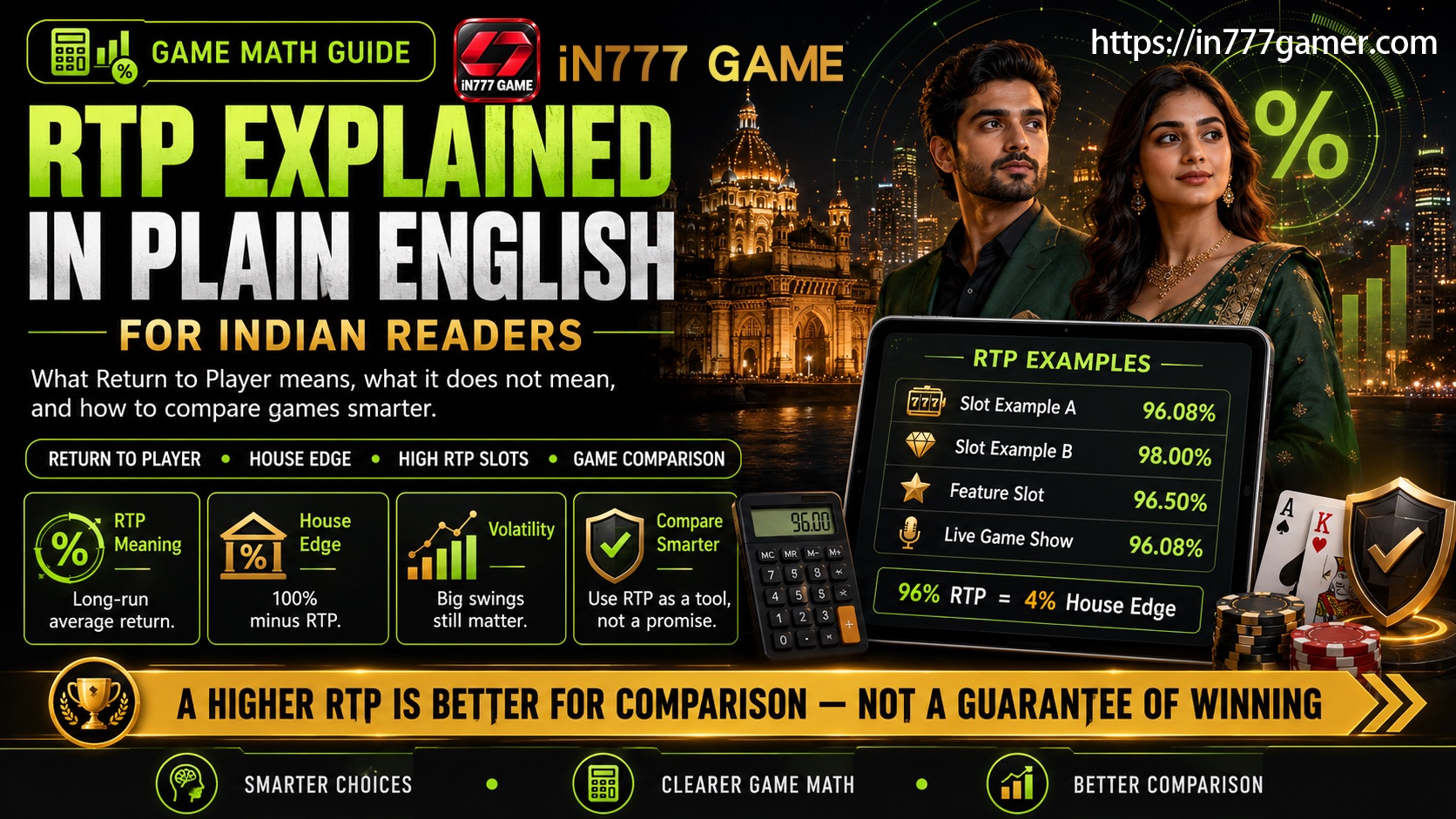
Return to Player, or RTP, is a theoretical percentage calculated across many rounds. It describes how much of all money wagered a game is designed to return over time. It cannot tell you what the next spin will pay, how tonight's session will finish or which betting pattern to use.
Turning RTP into House Edge
Subtract RTP from 100% to find the theoretical house edge. A 96% slot therefore leaves a 4% operator advantage over time. A higher RTP reduces that edge but cannot make a game predictable or profitable.
- 95% RTP corresponds to a 5% house edge
- 96% RTP leaves a 4% house edge
- 98% RTP leaves a 2% house edge
Why ₹1,000 Does Not Become ₹960
A 96% listing does not mean a ₹1,000 session should return ₹960. The model covers far more rounds than one person plays, while short sessions are shaped by variance. An early loss and an early feature can both fit the same RTP.
RTP and Volatility Answer Different Questions
RTP measures theoretical return; volatility describes how wins and losses tend to arrive. Two games with similar RTP may feel different: one can pay modest wins often, while another stays quiet before a larger swing.
Five Details Worth Checking Alongside RTP
- How often the game records a hit
- The feature rounds and advertised maximum win
- Rules for a table game or game-show format
- The RTP displayed inside the version you actually opened
- Whether the provider supplies more than one RTP setting for that title
The Myths a Percentage Cannot Support
A losing run does not make a slot 'due', and a recent jackpot says nothing about the next round. Bonus features are already part of the mathematical model. Even a high RTP cannot promise an individual profit.
Using RTP Responsibly in India
RTP is one useful comparison point. It does not settle local legal questions, remove financial risk or change the randomness of a round. Treat it as background, never as a reason to raise the stake.
Questions Players Often Ask
1. What is RTP? The theoretical share of wagers returned over a very long period.
2. Is volatility the same thing? No. It describes the size and spacing of swings.
3. Does RTP promise a win? No. It is not a personal forecast.
4. Can one game have different versions? Yes. Read the information screen in the version you open.
5. Is RTP a winning system? No. It compares games; it does not predict them.
Sources and Further Reading
Facts and definitions in this guide were checked against the following public sources: